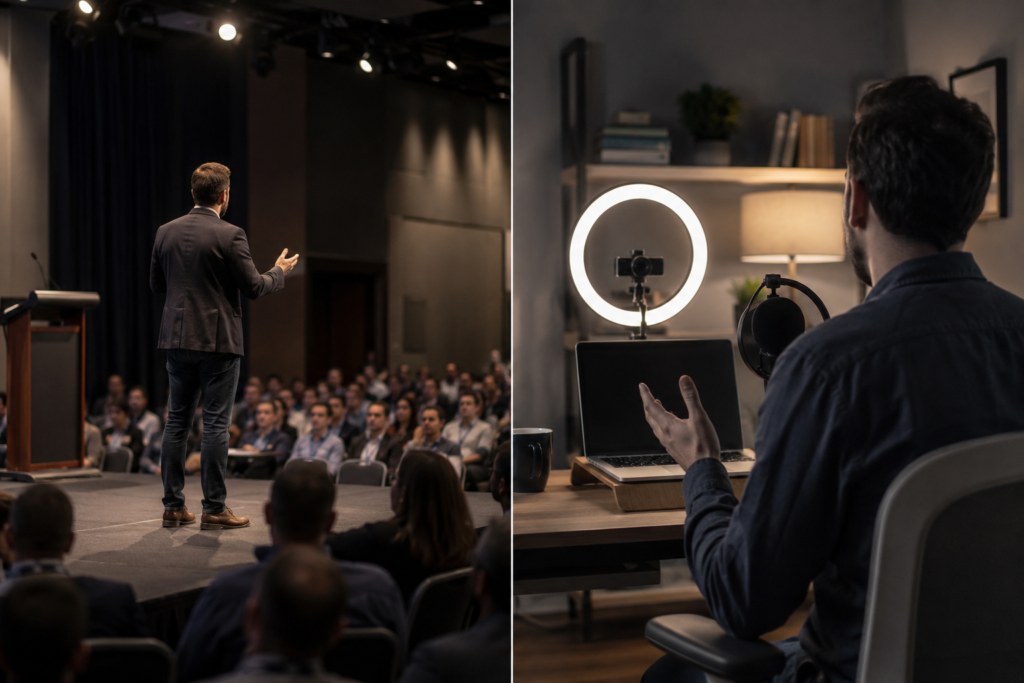
A few years ago, every conversation about virtual speakers came with an asterisk. It was framed as the backup plan, the thing you settled for when travel budgets got cut or a pandemic made the decision for you. That asterisk is gone now. Event planners aren’t asking whether virtual keynotes are “good enough” anymore. They’re asking which format actually serves the goal of their event, and increasingly, the honest answer is that it depends less on the speaker and more on what you’re trying to accomplish.
I’ve sat through this debate with enough clients over the past year to notice a pattern: the people who get the best results aren’t the ones who pick a format out of habit. They’re the ones who ask a few blunt questions first, then match the format to the answer.
Why This Question Keeps Coming Up
Budgets are tighter than they were five years ago, and travel costs haven’t gotten cheaper. At the same time, hybrid work has made people far more comfortable engaging with a screen than they used to be. A well-produced virtual keynote in 2026 doesn’t feel like a Zoom call bolted onto a stage. It feels like a broadcast, with the kind of production value that makes the format itself invisible.
That shift matters, because it means the old argument, that virtual is inherently a lesser experience, doesn’t really hold up anymore. What still holds up is that the two formats do different jobs.
What In-Person Still Does Better
There’s a reason companies still fly people in for major milestones: anniversaries, all-company kickoffs, the once-a-year event where the entire culture of the organization is on display. In-person keynotes carry a kind of weight that’s hard to replicate through a camera. The speaker can read the room mid-sentence and adjust. Attendees linger afterward, ask questions in the hallway, take photos, and that residue of the moment sticks around longer than the talk itself.
If your event is built around connection as much as content, meaning the point isn’t just what people hear but who they stand next to while they hear it, an in-person speaker is usually worth the extra cost. Certain topics also land harder live. A survivor sharing a personal story, a coach building energy before a big push, a comedian working a room: these formats depend on real-time feedback loops between speaker and audience that video calls still can’t fully reproduce.
Where Virtual Has Quietly Caught Up
The surprising part isn’t that virtual has become acceptable. It’s that for certain kinds of events, it’s become the better choice, not just the cheaper one.
Take a multi-office company doing a leadership briefing across time zones. Flying in a speaker for one location and streaming to the rest used to be standard. Now, a virtual keynote lets every office get the same experience at the same time, with the same production quality, without anyone feeling like they got the secondhand version. Recorded sessions can also be repurposed afterward for onboarding or internal training, which extends the value of the booking well past the live date.
Virtual also opens the door to speakers who would otherwise be out of reach. A busy author on a book tour, a scientist based overseas, an executive who can’t leave the country during a critical quarter: virtual formats remove the travel logistics that used to eliminate great options from the shortlist entirely. I’ve seen planners land speakers for a fraction of what an in-person fee plus travel would have cost, simply because the format made the booking logistically possible in the first place.
The Real Decision Isn’t Format. It’s Purpose.
The planners who get this right tend to ask three questions before they ever look at a speaker roster:
What’s the primary goal of this session? If it’s information transfer, a product update, a strategy briefing, a training session, virtual usually works fine and saves money that can go toward other parts of the event.
How much does the room’s energy matter to the outcome? If you’re trying to build morale, mark a milestone, or create a shared memory the team will reference for years, that’s a signal to lean in-person.
What’s the realistic production budget? A cheap virtual event, one with bad lighting, lag, and a static slide deck, can actually do more damage to how a speaker lands than a modest in-person setup would. If the virtual budget can’t cover decent production, it’s worth reconsidering the format entirely.
A Format That’s Often Overlooked: Hybrid
Hybrid events get a bad reputation, mostly because early attempts treated the remote audience as an afterthought, a camera pointed at a stage with no real thought given to what the online experience should feel like. Done properly, hybrid can be the best of both worlds: a core audience gets the in-person energy, while a broader audience joins remotely without anyone having to choose between reach and impact.
The key is designing for both audiences from the start, not bolting a stream onto an in-person event at the last minute. That usually means a speaker who’s genuinely comfortable working both a live room and a camera, along with a production team that treats the virtual feed as its own experience rather than a leftover.
Hybrid also tends to work best when the two audiences aren’t expected to have identical experiences, just equally good ones. The in-person crowd might get a longer Q&A session or a meet-and-greet afterward, while the remote audience gets a cleaner camera angle, better audio, and maybe a chat feature that lets them ask questions in real time without interrupting the room. Trying to make both experiences literally the same usually ends up shortchanging one side or the other. Treating them as parallel, each optimized for its own format, tends to produce better feedback across the board.
One thing worth flagging: hybrid events usually cost more to produce well than either format on its own, since you’re effectively running two productions at once. It’s not a shortcut to save money. It’s a tool for reach, and it only pays off when the extra reach is actually worth the extra production lift.
A Quick Gut Check Before You Book
If you’re still on the fence, a simple test helps: picture the event a week after it happens. In the in-person version, what are people remembering, the content, or the room? In the virtual version, are they still referencing something useful from the session, or did it blur into the dozens of other video calls that week? If you can’t picture people getting real value a week later in either version, the problem probably isn’t the format. It’s the speaker or the topic, and that’s worth solving first before deciding how to deliver it.
What This Means for Your Next Booking
None of this means one format has won. It means the conversation has matured past a simple either-or. The planners getting the most out of their speaker budget are the ones who start with the outcome they want, then work backward to the format and speaker who can actually deliver it.
If you’re weighing this decision for an upcoming event, it helps to talk it through with people who book both formats regularly and can tell you honestly which one fits your specific goals, rather than defaulting to whatever’s easiest to arrange. PDA Speaker Group works with organizations across both formats every week, matching speakers to the outcome the event is actually built around, not just the budget line it falls under. Their virtual speaker roster spans everything from keynote addresses to interactive fireside chats, built specifically for teams that want the impact of a great speaker without the logistics of a live production.
Whichever direction you land on, the format should serve the goal of the event, not the other way around. Get that order right, and the rest of the planning tends to fall into place.