For a long time, digital marketing had a relatively simple playbook.
Create content.
Target keywords.
Rank on Google.
Get traffic.
Convert that traffic into customers.
That model still works.
But the environment around it is changing.
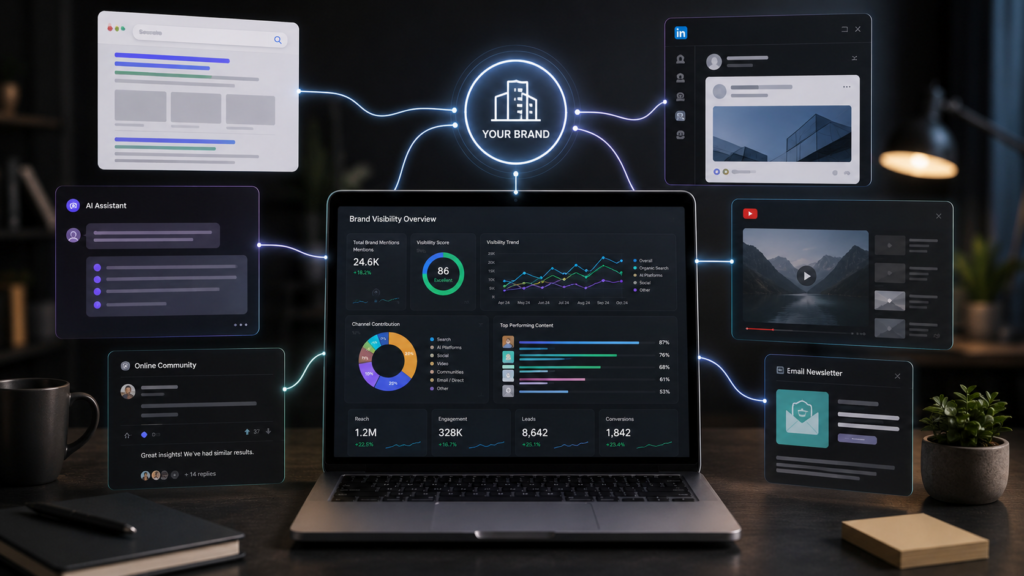
People no longer rely on a single search engine to discover information, evaluate businesses or make purchasing decisions. They search on Google, ask ChatGPT, watch YouTube videos, browse LinkedIn, read Reddit discussions, explore communities and increasingly interact with AI-powered answer engines.
This changes what it means to be visible online.
The opportunity is no longer simply to rank.
It is to be discoverable wherever your audience is looking.
Search Is Becoming a Distributed Experience
Think about how someone researches a product or service today.
They might start with a Google search.
Then they may:
- Watch a YouTube review
- Check LinkedIn for the company’s credibility
- Read Reddit discussions
- Ask an AI tool for recommendations
- Visit the company’s website
- Search the brand name directly
- Look at reviews before making a decision
Google may still be part of the journey, but it isn’t necessarily the entire journey.
This creates a problem for businesses that have built their entire acquisition strategy around organic search traffic.
If your visibility exists only in Google’s search results, you are dependent on one distribution channel.
And every platform eventually changes.
Algorithms change. Search interfaces change. User behaviour changes. Competition changes.
The businesses that adapt are the ones that build visibility beyond a single platform.
The Real Asset Is Not Traffic
Traffic is useful.
But traffic itself isn’t the asset.
A visitor who discovers your website today and forgets your brand tomorrow isn’t creating much long-term value.
Compare that with someone who:
- Discovers your company through Google
- Sees your content again on LinkedIn
- Watches one of your YouTube videos
- Reads a useful answer from your team
- Remembers your brand
- Searches for your company directly a month later
That journey is much more powerful.
The objective isn’t simply:
“How many people visited our website?”
It is:
“How many people now know, trust and remember our brand?”
That is a very different way of thinking about digital visibility.
AI Makes Generic Content Less Valuable
AI has made information dramatically easier to produce.
That is both an opportunity and a problem.
If hundreds of businesses publish articles explaining the same basic topic using the same commonly available information, there is very little reason for an AI system, search engine or user to prefer one piece over another.
Generic information is becoming increasingly abundant.
Original information is becoming more valuable.
That means businesses should invest in things AI cannot simply recreate from existing pages:
- Original research
- First-hand experience
- Customer insights
- Proprietary data
- Expert opinions
- Case studies
- Experiments
- Unique frameworks
- Strong points of view
- Real examples and lessons learned
Instead of asking:
“What article should we publish for this keyword?”
Ask:
“What can we teach that hundreds of other websites cannot?”
That question leads to much stronger content.
Build a Brand People Search For
One of the biggest opportunities in this environment is branded demand.
There is a major difference between someone searching:
“best accounting software for small business”
and someone searching:
“[Your Brand] accounting software reviews”
The first search is category demand.
The second is brand demand.
When people start searching for your company specifically, you are no longer completely dependent on competing for generic keywords.
Your brand has entered the customer’s consideration set.
That is why content marketing should not only capture existing demand.
It should also create demand.
Your content should make people think:
“I want to learn more from this company.”
That can happen through insightful LinkedIn posts, useful YouTube videos, original research, newsletters, podcasts, case studies, communities and genuinely helpful resources.
Search Everywhere Optimization
This is where the idea of Search Everywhere Optimization becomes important.
The goal is not to abandon SEO.
SEO remains an important foundation.
The goal is to expand the definition of search visibility.
Your potential customer might search for your category on Google.
They might search for your founder on LinkedIn.
They might look for product demonstrations on YouTube.
They might ask an AI assistant which companies are worth considering.
They might search Reddit for real customer experiences.
They might discover your newsletter through another creator.
Each of these is a discovery opportunity.
Your brand should have something valuable to say across these environments.
What Marketing Teams Should Start Measuring
If the strategy expands beyond traditional search, measurement needs to expand too.
Organic sessions still matter.
Rankings still matter.
But they should not be the only numbers on the dashboard.
Start paying attention to:
- Branded search growth
- Direct traffic
- Brand mentions
- AI citations and recommendations
- Social engagement
- Video views and watch time
- Newsletter subscribers
- Returning visitors
- Assisted conversions
- Qualified leads
- Content-influenced revenue
- Community engagement
These metrics tell you whether your marketing is building an audience and a brand, rather than simply generating temporary clicks.
The Strongest Strategy Combines Search and Brand
This doesn’t mean businesses should stop doing keyword research.
It doesn’t mean technical SEO suddenly becomes irrelevant.
It doesn’t mean Google doesn’t matter.
It means SEO should become part of a broader visibility strategy.
Use SEO to capture existing demand.
Use content to demonstrate expertise.
Use social platforms to build familiarity.
Use video to explain and demonstrate.
Use communities to participate in real conversations.
Use email to build an owned audience.
Use original research to create something worth referencing.
Use your website to convert attention into relationships.
The pieces reinforce each other.
Someone may discover you through Google, follow you on LinkedIn, watch your video, subscribe to your newsletter and eventually become a customer.
That is far more resilient than relying on a single search result.
The Question Businesses Should Be Asking
The future of search isn’t necessarily about getting fewer searches or more searches.
It is about where those searches happen and how your brand appears during the journey.
So instead of asking only:
“How do we rank for this keyword?”
Start asking:
“Where does our audience go to discover, evaluate and validate a business like ours?”
Then build visibility there.
Because the strongest brands won’t simply have pages that rank.
They will have ideas that get referenced, experts that get followed, content that gets shared, videos that get watched, communities that trust them and a brand people actively search for.
Google can send you a visitor.
A strong brand gives that visitor a reason to come back.
That is the real opportunity in the next phase of search.