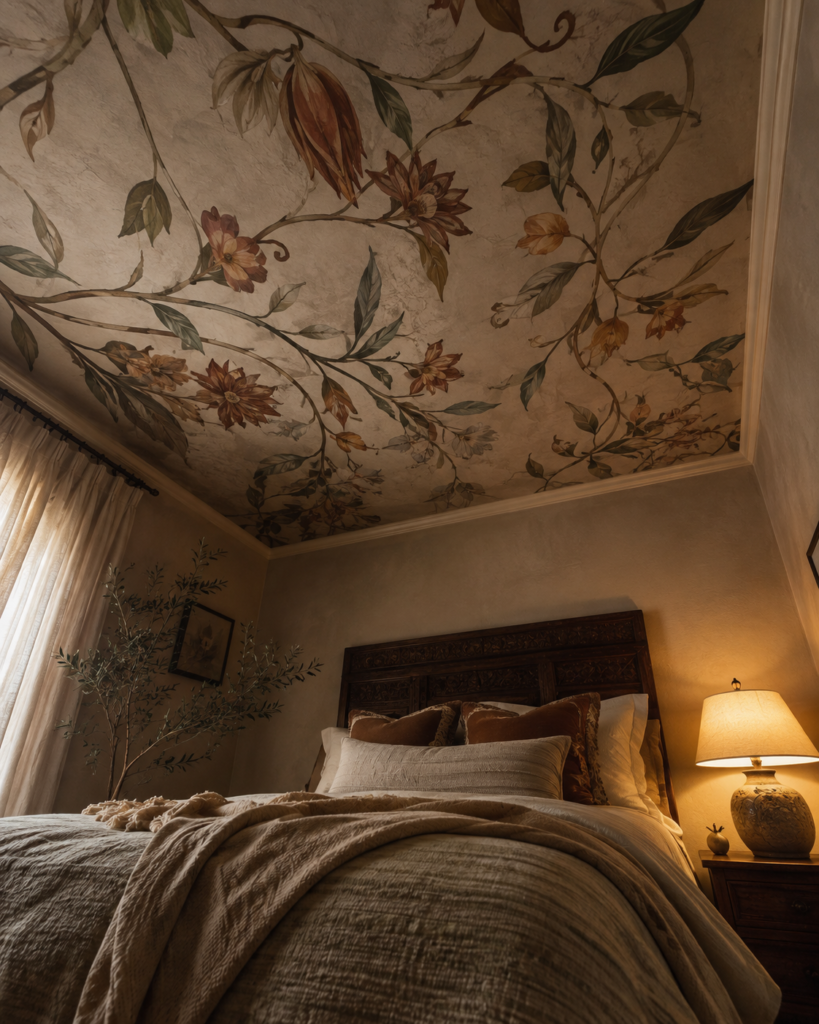
For as long as most people can remember, the ceiling has been the one surface in the house nobody thinks about. It gets a coat of flat white paint when the walls get painted, mostly so it doesn’t look neglected, and then it disappears from consideration entirely. Furniture gets rearranged. Walls get gallery displays. Floors get new rugs every season. The ceiling just sits there, quietly ignored, doing its job and nothing more.
That’s changing, and it’s changing fast. Homeowners and designers are starting to treat the ceiling as what it actually is: a full wall’s worth of surface area that happens to be overhead. People are calling it the fifth wall, and once you start noticing the phrase, you start noticing how many rooms are being redesigned around it.
How a Blank Surface Became a Blank Canvas
The shift didn’t happen overnight. For years, ceilings got a small amount of attention in very specific rooms, mostly nurseries or the occasional dining room with a chandelier worth showing off. Everywhere else, the unspoken rule was simple: keep it plain, keep it light, keep it out of the way.
A few things pushed against that rule at once. Open floor plans, which had dominated home design for over a decade, started to feel a little too exposed for a lot of people. Rooms with fewer walls to decorate meant homeowners were suddenly short on surfaces to express any personality at all. The ceiling, previously the most overlooked real estate in the house, became one of the few large, uninterrupted spaces left to work with.
At the same time, there’s been a broader move toward rooms that feel enveloping rather than open and airy. After years of minimalist, all-white interiors dominating design feeds, a lot of people started craving spaces that felt more like a retreat than a showroom. A room wrapped in color, pattern, or texture from floor to ceiling creates a very different feeling than a room where the eye eventually drifts up to a flat, empty plane. Designers started calling this the cocoon effect, and the ceiling turned out to be essential to pulling it off. You can’t fully wrap a room in warmth or drama if the top of it stays blank.
What the Fifth Wall Actually Looks Like
The trend isn’t one single look. It’s a whole category of techniques, and different homeowners are leaning into different versions depending on how bold they want to go.
Hand-painted murals are probably the most dramatic expression of the trend. Instead of a flat color, the ceiling becomes an actual scene: clouds drifting across a soft sky, botanical patterns creeping across the plaster, abstract shapes and color fields that give a room the feeling of standing inside a piece of art rather than just looking at one on the wall. These murals take real skill and time, which is part of the appeal. A hand-painted ceiling can’t be mass produced or picked up at a home goods store, so it becomes a genuinely personal feature of the house.
Dramatic wallpaper is the more accessible cousin of the mural. Modern wallpaper has come a long way from the busy florals people associate with older homes. Bold graphic prints, deep saturated colors, and metallic finishes are increasingly showing up overhead, in bedrooms, powder rooms, and even living spaces. Wallpapering a ceiling is admittedly trickier than wallpapering a wall, since gravity doesn’t cooperate the same way, but the payoff is a room that feels finished and considered in a way flat paint rarely achieves.
Then there’s the architectural route: 3D textures, coffered panels, wood slats, plaster relief work, and other techniques that add physical depth rather than just color or pattern. These treatments catch light differently throughout the day, casting subtle shadows that shift as the sun moves. A textured ceiling doesn’t just sit above a room, it actively shapes how that room feels at different times, brighter and flatter at midday, moodier and more dimensional in the evening.
Why This Resonates With Homeowners Right Now
Part of the appeal is simply novelty. After a long stretch where most homes followed a fairly similar playbook of neutral tones and safe choices, a bold ceiling offers a way to stand out without redoing an entire room. It’s a single surface that can transform the character of a space without touching the furniture, the flooring, or the walls at all.
There’s also a practical angle that gets overlooked. A statement ceiling can solve a problem a lot of homes actually have: rooms that feel like they lack a focal point. Instead of relying on furniture arrangement or a single piece of art to anchor a room, the ceiling itself becomes the anchor, the thing your eye is drawn to the moment you walk in.
Smaller rooms benefit in a particular way too. There’s a long standing assumption that a bold or dark ceiling will make a small room feel cramped, but a lot of designers have found the opposite tends to happen. A patterned or richly colored ceiling can actually make a small room feel more intentional and cozy rather than cramped, especially when it’s paired with softer, simpler wall treatments. The room stops feeling like an unfinished box and starts feeling like a designed space with a clear point of view.
There’s also something to be said for how photogenic these rooms have become, which has helped the trend spread faster than it might have a decade ago. A dramatic ceiling makes for a far more interesting photograph than another neutral living room, and that visibility has pushed more homeowners to consider trying it themselves.
Getting Started Without Overcommitting
Not everyone is ready to hand-paint a mural on their first attempt, and that’s fine. The trend scales well for people who want to dip a toe in before going all in.
A small space is usually the easiest starting point. Powder rooms, entryways, and reading nooks are low-risk places to experiment with a bold ceiling, since the square footage is small enough that even a dramatic choice won’t overwhelm the budget or the room. If it doesn’t work out, it’s a much smaller undo than redoing an entire living room ceiling.
Removable wallpaper has also made the trend far less intimidating for renters and commitment-averse homeowners alike. It offers a way to test out a pattern or color overhead without a permanent installation, which lowers the stakes considerably for anyone who isn’t sure they’re ready to live with a bold choice for years.
Texture without heavy color is another entry point. Simple wood slats or subtle plaster detailing can add depth and interest to a ceiling without introducing a strong color commitment, which appeals to homeowners who want the cocoon effect without straying too far from a more neutral overall palette.
Also read: Bio-Harmony Eating: Why Your Body Doesn’t Want a Generic Diet
A Surface Finally Getting Its Due
What’s really happening here isn’t just a design trend, it’s a bit of a correction. Ceilings make up roughly the same amount of surface area as the floor in most rooms, yet they’ve spent decades being treated as an afterthought while every other surface got attention and investment. The fifth wall movement is simply catching that surface up to the rest of the room.
Whether it’s a full mural, a bold paper, or a textured architectural detail, the underlying idea is the same: a room isn’t finished until you’ve looked up. For a growing number of homeowners across the country, that’s no longer a throwaway line. It’s becoming the first thing they think about when a room gets redesigned, not the last.