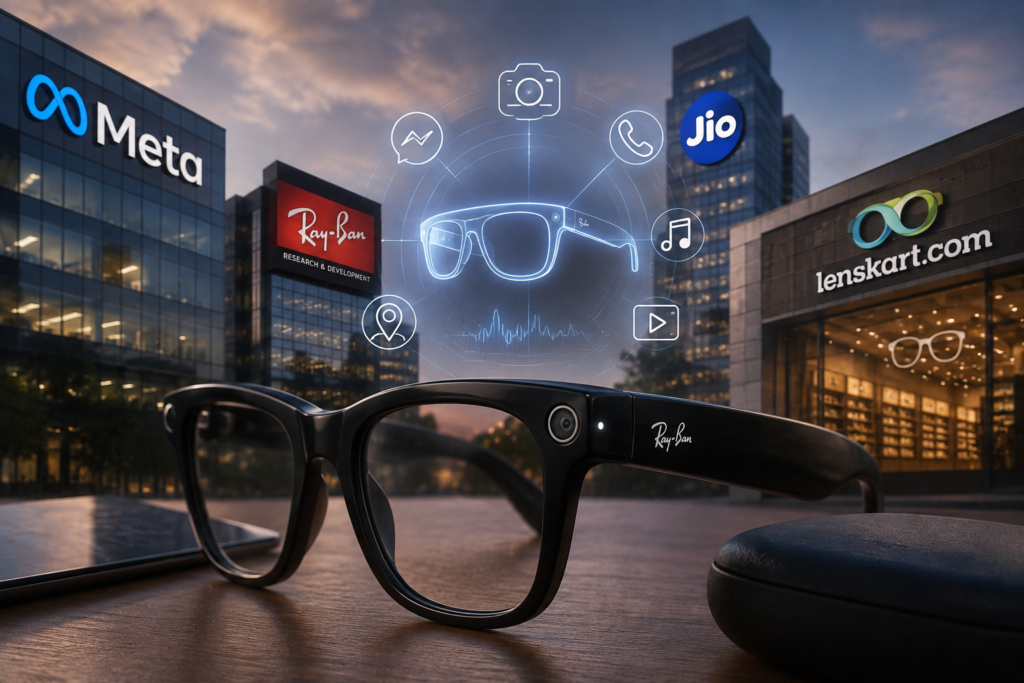
Smart glasses are one of those products that make perfect sense when you look at them from a product perspective.
More than 4 billion people already wear spectacles. That means companies don’t have to convince billions of people to put an unfamiliar device on their face. They only have to add useful technology to something millions of people already use every day.
That’s a powerful starting point.
Meta has already pushed smart glasses into the mainstream through its partnership with Ray-Ban. Jio is working on a more affordable offering in India, Lenskart has entered the category, and other major technology companies are watching closely.
The race is clearly about what glasses can do.
But there is another question that deserves just as much attention:
What happens to the people being looked at?
The Phone Used to Give Us a Signal
There was a time when recording someone in public was fairly obvious.
Someone took out a phone.
They pointed it at you.
You could usually tell what was happening.
Smart glasses change that social signal.
Someone wearing ordinary-looking glasses could be listening to music, checking information, taking a photograph, recording a video, or interacting with an AI assistant.
From the outside, those activities can look exactly the same.
That creates a problem that isn’t really about technology.
It’s about trust.
Imagine sitting across from someone in a café.
They’re wearing smart glasses.
Are they listening to you?
Are they recording you?
Are they taking a picture?
Or are they simply wearing glasses?
You may never know.
A Recording Light Is Not Enough
Some smart glasses already include an external indicator that shows when the camera is recording.
That’s a useful step.
But there is a difference between having a privacy feature and having a privacy signal people actually understand.
If the person standing in front of the camera doesn’t know what the light means, the feature hasn’t solved the entire problem.
People shouldn’t need to read a product manual to understand whether they’re being recorded.
The signal needs to be obvious, consistent and difficult to miss.
And ideally, it shouldn’t change from one manufacturer to another.
If one brand uses a light, another uses a sound, and another uses a completely different indicator, the public has to learn a new language for every pair of glasses.
That won’t scale.
The Person in Front of the Camera Matters Too
Product teams naturally think about the person buying the product.
That’s understandable.
The customer is the person paying for it.
But connected devices increasingly affect people who never purchased them.
A camera affects the person being photographed.
A doorbell camera affects people walking past a house.
A microphone affects people having a conversation nearby.
Smart glasses affect almost everyone around the wearer.
That means the person in front of the camera should also be considered when the product is being designed.
Not as an obstacle.
Not as an afterthought.
As part of the product experience.
That’s an important shift in thinking.
Privacy Should Be Designed Into the Product
There are several relatively simple things manufacturers could explore.
A recording indicator could be positioned somewhere highly visible and consistent across the category.
A capture sound could provide another clear signal, particularly in situations where a visual indicator might not be noticed.
Manufacturers could establish common expectations around recording so people don’t have to understand the technical details of each device.
And perhaps most importantly, companies could treat misuse as something to design against rather than something to address only after problems appear.
None of these measures will eliminate misuse.
Nothing will.
A smartphone can be misused. A camera can be misused. A laptop can be misused.
But good product design can make irresponsible behaviour harder and responsible behaviour easier.
That’s the part worth focusing on.
The Same Technology Can Create Very Different Outcomes
The interesting thing about smart glasses is that the technology itself isn’t good or bad.
The same camera can be incredibly useful for a food creator filming a recipe hands-free.
It can help someone document a travel experience without constantly holding a phone.
It can provide accessibility features.
It can help professionals capture information while keeping their hands free.
It can make everyday computing more natural.
But that same camera can also capture someone who never agreed to be recorded.
The technology doesn’t decide which outcome becomes normal.
The product design, social norms and safeguards around it do.
This Is the Moment to Get It Right
Smart glasses are still early enough in their adoption curve that companies have an opportunity to establish expectations before bad habits become normal.
That’s important.
Once millions of people become accustomed to a particular behaviour, changing it becomes much harder.
The industry shouldn’t wait for a major privacy controversy before asking how people should know when they’re being recorded.
It should ask that question now.
Because the success of smart glasses won’t only depend on battery life, camera quality, AI features or price.
It will also depend on whether people around the wearer feel comfortable sharing the same space with them.
Technology becomes truly useful when people trust it.
And trust isn’t something you add in a software update.
You design for it from the beginning.