There’s a quiet split happening in SEO right now, and almost nobody in the SaaS world has caught up to it.
For years, the backlink playbook was simple. Find a site with a high Domain Rating, get a guest post or a mention on it, watch your rankings creep up. It worked. It still works, technically. Your Google rankings can look great this month.
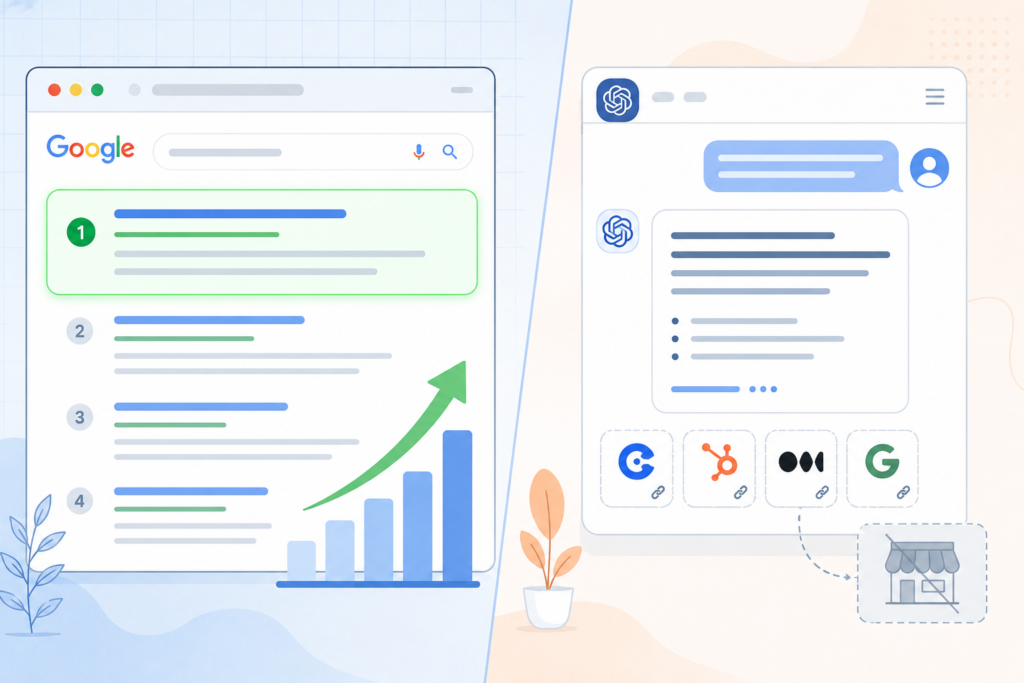
But open ChatGPT or Perplexity and ask the same question a buyer would ask — “best project management tool for remote teams,” “top CRM for small agencies,” whatever your category is — and a strange thing happens. Your brand is often nowhere. Meanwhile a competitor with a fraction of your backlink profile shows up by name, sometimes with a link straight to their G2 page.
That’s not a fluke. It’s a completely different scoring system, and most SaaS teams are still only optimizing for the old one.
Two Search Engines, Two Very Different Judges
Google’s ranking system and an AI model’s answer-generation system are not the same animal, even though we’ve been treating them like cousins.
Google is largely a link-and-authority machine. It crawls the web, counts who’s linking to whom, weighs the authority of the linking domain, and factors in a pile of other signals to decide what deserves the top spot. A guest post on a DR 70 blog, even one that has nothing to do with your industry, still passes some authority. Google rewards that.
AI models work differently. When ChatGPT or Perplexity answer a question, they’re not ranking pages in the traditional sense — they’re pulling from a training set and, increasingly, from live retrieval of content that looks trustworthy, specific, and worth citing. They’re looking for pages that read like genuine expertise on the exact topic being asked about, not pages that merely happen to have a big number attached to them.
This is why review sites keep surfacing in AI answers. G2, Capterra, TrustRadius — these aren’t just high-authority domains. They’re structured, topically dense, comparison-heavy pages built entirely around “best X for Y” type questions. That’s exactly the shape of content an AI model wants to lean on when someone asks a category question. The AI isn’t citing G2 because G2 has strong domain authority. It’s citing G2 because G2’s whole existence is answering the question being asked.
Why Your DR 70 Guest Post Isn’t Showing Up
Here’s the part that stings a little. That guest post you paid for on a massive, generic marketing blog? It’s probably doing exactly one job: helping your Google rankings inch up. It is very likely doing nothing for how AI models talk about you.
Not because the link is bad. Not because the site is low quality. It’s because the page itself has no reason to be treated as a source on your category. If the post is a broad “10 tools to boost productivity” roundup sitting on a blog that covers everything from marketing to finance to lifestyle, there’s nothing about that page that signals deep, specific authority on your exact niche. An AI model has no reason to pull from it when someone asks a pointed question about your space.
Domain Rating was already a somewhat blunt instrument for Google, honestly — plenty of SEOs have quietly admitted that a high DR link on an irrelevant, low-traffic page doesn’t move the needle the way it used to. Now the same metric is basically irrelevant to the other half of the game. A number that measures raw backlink volume tells you nothing about whether a page is topically credible enough for an AI system to treat it as a citation-worthy source.
What Actually Works for Both
The good news is you don’t need two separate strategies running in parallel. There’s a category of content that does double duty.
A guest post placed on a site that’s genuinely relevant to your industry — not just generically “authoritative” — can rank you on Google and get picked up as a source by AI tools. Think about the difference between a guest post on a broad lifestyle blog versus one on a niche site that specifically covers your category, written with real specificity, comparisons, and depth.
The pattern is consistent: topical relevance plus specificity beats raw domain authority when it comes to AI visibility. A smaller, focused site that’s clearly “about” your space is more valuable for this purpose than a massive general blog that happens to have a huge backlink profile.
This changes how you should be thinking about where to place content:
- Prioritize sites and publications that live inside your category, even if their DR is lower than the generic blogs you’ve been chasing.
- Push for content that reads like an actual comparison or breakdown, not a thin mention wrapped around a link.
- Treat review platforms like G2 and Capterra as real distribution channels, not just a box to check for social proof. Keep your profiles detailed, current, and rich with the kind of language buyers actually search for.
- Stop assuming that a high DR number automatically means the placement is doing anything for you beyond a small nudge in Google rankings.
The Question Nobody’s Asking Their Own Content
Here’s a simple exercise most SaaS marketing teams have never actually done: open ChatGPT or Perplexity right now and type the exact question your ideal customer would type when they’re comparing tools in your category. See if your brand comes up at all. Then check what does show up, and notice what those pages have in common.
Chances are it’s not the highest DR site you can think of. It’s the site that’s most obviously, specifically about the exact question being asked.
Ranking on Google used to feel like crossing the finish line. It isn’t anymore. It’s one of two finish lines, and right now, most SaaS teams are still only running toward the one they can see.