

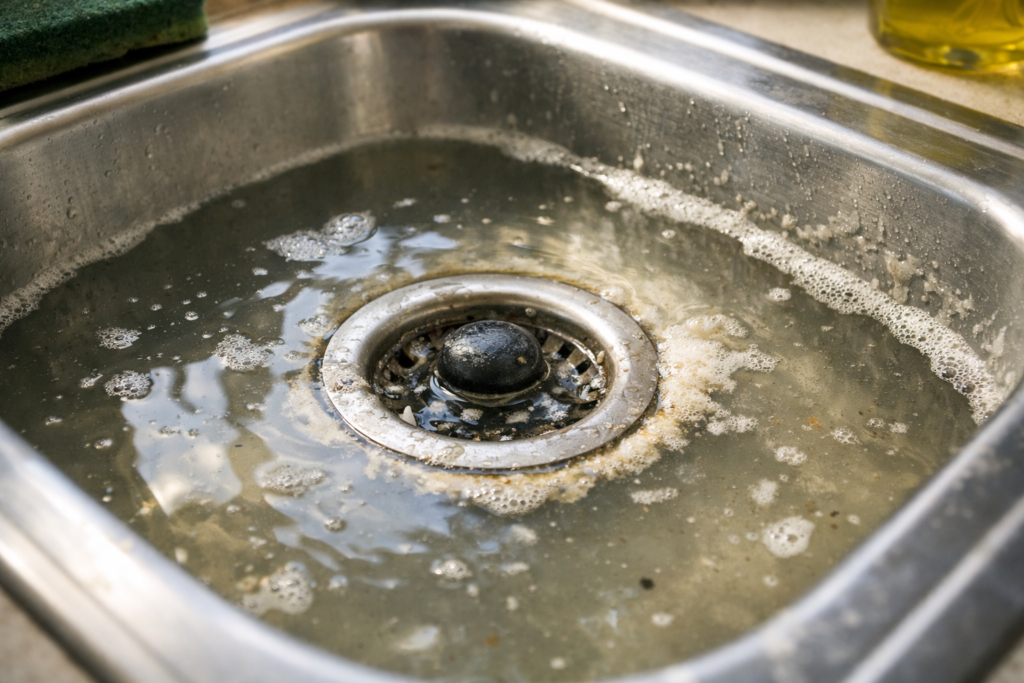
There’s a particular kind of frustration that comes with a blocked kitchen sink. It starts as a slow drain — water pooling around your feet for a few extra seconds. You tip some bicarb and boiling water down there, it clears up, and you forget about it. Then three weeks later it’s back, worse than before, and this time the bicarb does nothing.
If this sounds familiar, you’re not dealing with bad luck. You’re dealing with a grease problem — and grease does not respond to the DIY treatments most of us reach for first.
This is what’s actually happening inside that pipe, why it keeps returning, and what a proper drain clean does that a bottle of drain cleaner never will.
The real cause: it’s almost never what you washed down once
Most kitchen drain blockages in Sydney homes are caused by the slow accumulation of fats, oils, and grease — what the plumbing industry calls FOG. Every time you rinse a frying pan, wash a plate with leftover sauce, or tip out cooking oil you assumed was too small a quantity to matter, a thin film of grease coats the inside of your drainpipe.
Here’s the thing about grease: it doesn’t stay liquid once it’s inside your pipes. Hot water and drain cleaner might push it further down, but as the water cools, the grease solidifies back onto the pipe wall. Layer by layer, over months and years, the internal diameter of your drain narrows. Food scraps, soap residue, and coffee grounds start catching on the rough, sticky surface. Eventually the pipe is running at a fraction of its original capacity — and then one day, it stops entirely.
A study by Sydney Water found that FOG (fats, oils and grease) is one of the leading causes of residential sewer blockages across NSW — and most of it comes from household kitchens, not commercial ones.
The slow drain you’ve been putting up with for six months isn’t a minor inconvenience. It’s a pipe that’s running at maybe 30–40% of its capacity. The full blockage was always coming.
Why boiling water and drain cleaner keep failing you
Boiling water works on fresh grease. If you’ve just cooked something and you rinse the sink immediately with very hot water, it can push the grease further along before it solidifies. As a prevention habit, it’s not bad. As a fix for an established build-up, it doesn’t touch the sides.
Chemical drain cleaners — the caustic lye-based products — are designed to dissolve hair and organic matter. They do a reasonable job on bathroom drains. On a grease-coated kitchen pipe, they generate heat and dissolve whatever’s sitting loose in the water column, but they don’t scrub the pipe walls. The hardened grease layer that’s been building for two years? It’s still there. You’ve just bought yourself a temporary reprieve.
There’s also a secondary problem. Caustic drain cleaners are corrosive. Used repeatedly on older pipes — and a lot of Sydney’s housing stock still has copper or galvanised steel kitchen drains — they accelerate pipe degradation. You can end up trading a grease problem for a pipe integrity problem.
The sink plunger situation
A plunger works well on a full physical obstruction — something solid sitting in a trap or close to the drain opening. On a grease build-up that’s distributed along a metre or more of pipe, it does very little. You might shift enough material to get things flowing again for a day or two, but the surface area of the blockage barely changes.
What a high-pressure drain clean actually does
Professional drain cleaning for a kitchen blockage uses a high-pressure water jetter — a machine that forces water through a specialist nozzle at up to 5,000 psi. That pressure isn’t just pushing the blockage along. The nozzle is designed to project jets of water backwards as well as forwards, so as it travels down the pipe it’s simultaneously scrubbing the walls in all directions.
The grease that’s been building for two years gets broken up and flushed out. The pipe walls get clean — not just the centre channel. When a CCTV camera then goes down after the jetter, you can actually see the difference: a pipe that was heavily coated looking essentially new.
This is why one professional drain clean typically holds for 18 months to two years in a normal household kitchen, whereas DIY methods might hold for a few weeks. You’re solving a different problem at a different level.
When CCTV inspection matters
For kitchens that have blocked repeatedly over a short period — say, three times in 12 months — a CCTV inspection is worth doing alongside the clean. Grease build-up is the most common cause, but it’s not the only one. A camera run through the line can identify:
- A partial pipe collapse causing water to pool and grease to accumulate faster than normal
- Tree root intrusion into a junction further down the line
- A cracked or offset pipe joint from ground movement
- A ventilation issue causing syphoning that pulls debris into the trap
None of these show up in any chemical treatment or plunger session. And none of them get fixed by clearing the grease alone — they’ll just cause the same blockage to return faster.
How to slow grease build-up between professional cleans
You can’t completely prevent FOG from entering your drain — normal cooking and dish-washing will always introduce some. But a few habits make a real difference to how fast the build-up occurs.
- Let pans cool after cooking and wipe excess fat into the bin with a paper towel before washing.
- Don’t pour liquid cooking oil down the drain regardless of the volume. Bottle it and bin it, or use a local cooking oil recycling point if your council offers one.
- Run hot water for 30 seconds after washing greasy dishes — not before, which is the habit most people have.
- Use a sink strainer. They’re $4 and they catch the food particles that make grease build-up stick faster.
- Once a week, boil the kettle and pour it slowly down the drain after doing the dishes. This won’t fix an existing problem but it does soften the day’s grease before it can fully solidify.
None of this eliminates the need for a professional clean every year or two. But households that follow these habits consistently tend to go much longer between blockages.
The case for not waiting until it’s fully blocked
A drain that’s running slowly but not fully blocked is actually easier and cheaper to fix than one that’s completely stopped. More importantly, it’s a lot less disruptive — you’re not dealing with a sink full of dirty water, no kitchen access, and a same-day emergency callout.
If your kitchen drain is consistently slower than it used to be, that’s the signal to act. A pre-emptive clean on a slow drain takes less time, uses less water pressure, and carries no risk of the backup getting into your cabinets or under the floor.
Think of it the same way you think about a car service. You don’t wait for the engine to fail. The slow drain is your oil warning light.
This post was written by Express Drain Cleaning expert based in Sydney.
Express Drain Cleaning services kitchen drains across Sydney, the Central Coast, and Newcastle using high-pressure water jetters and CCTV inspection equipment. $0 call-out fee during business hours, same-day availability for urgent jobs. If your kitchen sink has been giving you trouble, it’s worth getting it looked at before the full blockage arrives.
