There’s a particular kind of optimism that takes over when something goes wrong in a house. The drain’s running a bit slow? Probably fine. There’s a faint damp smell near the bathroom wall? Must be condensation. The hot water takes four minutes to run warm? That’s just how old systems work.
Sydney homeowners are good at this. Not because they’re careless — most people genuinely care about maintaining their homes — but because plumbing problems tend to start quietly, and quiet problems are easy to reason away.
The trouble is, plumbing doesn’t stay quiet for long. What begins as a slow drain in April can become a completely blocked sewer line by July. A small leak behind a wall, left unaddressed through winter, can rot through timber framing and invite mould into cavities you can’t see without pulling the walls apart. And a hot water system that’s been “a bit unreliable” for a few months often fails completely on the coldest night of the year.
If you own a home — or rent one and want to protect yourself from nasty surprises — these are the warning signs worth knowing.
1. Your Water Pressure Has Quietly Dropped
This one is easy to miss because it happens gradually. Your shower was strong six months ago, and now it’s just… fine. Not bad enough to complain about, but not what it used to be.
Reduced water pressure is often dismissed as a supply issue — something to do with the mains, nothing you can control. But in many cases it points to a problem inside the home: a slow leak somewhere in the supply lines, a partially blocked or corroded pipe, or a failing pressure regulator.
The key thing to understand is that a leak doesn’t need to be dramatic to cause damage. A pinhole leak inside a wall cavity losing a small but steady amount of water will, over weeks and months, saturate the material around it. Plasterboard goes first, then timber, and once moisture gets into wall cavities for long enough, mould follows.
If your pressure has noticeably dropped and there’s no obvious reason — no work being done on the street, no recent changes inside the home — it’s worth having someone run a proper pressure test and check for hidden leaks before the problem gets bigger.
2. There’s a Musty Smell You Can’t Trace
A damp or musty smell inside a house is one of those things that people adapt to without realising it. Guests notice it immediately when they walk in. The people who live there stopped smelling it weeks ago.
Persistent damp odours — especially in bathrooms, laundries, under kitchen benches or near external walls — are often the first sign of water going somewhere it shouldn’t. It might be a slow leak from a supply pipe, a failed seal around the base of a toilet, or water getting into the wall cavity from a shower recess that wasn’t properly waterproofed during a renovation.
Mould doesn’t need much. Give it moisture, a dark space and something organic to grow on — like timber framing or paper-faced plasterboard — and it establishes quickly. By the time you can see it on a surface, it’s usually well established inside the wall. And certain types of mould present real health risks, particularly for children, older adults and anyone with respiratory conditions.
If there’s a smell you can’t explain and it keeps coming back no matter how much you clean and ventilate, stop treating the symptom and start looking for the source.
3. A Drain That’s Slow but Never Quite Blocked
Most people reach for a bottle of drain cleaner when a drain slows down, get a partial result, and consider the problem solved. And sometimes that’s true — a minor build-up of hair or grease near the drain opening can be cleared that way.
But a drain that slows down repeatedly, or that never quite runs freely even after treatment, is usually signalling something further down the line. The most common culprit in established Sydney suburbs — particularly homes built before the 1980s — is tree root intrusion into clay or concrete sewer pipes.
Roots follow moisture. A hairline crack in an old sewer pipe is all the invitation they need. Once inside, they grow steadily, catching debris and building up until water can barely pass. At some point the drain stops working entirely, and if that blockage is deep enough in the system, sewage can back up through multiple fixtures in the house simultaneously.
This is not a problem that drain cleaner, boiling water or a household plunger will fix. A CCTV drain inspection — where a small waterproof camera is fed through the pipe — is the only way to see what’s actually happening inside the line and make an informed decision about how to deal with it.
4. Your Hot Water Is Inconsistent or Takes Forever to Arrive
Hot water systems don’t fail overnight — they degrade. And the degradation usually announces itself well before the complete failure.
Signs that a hot water system is on the way out include water that takes much longer than usual to run warm, temperature that fluctuates during a shower for no obvious reason, a popping or rumbling sound from the unit, water that comes out slightly discoloured, or a visible puddle forming around the base of the tank.
The popping sound, in particular, is one that gets ignored more than it should. It’s caused by mineral sediment — most commonly calcium — building up on the bottom of the tank over time and heating unevenly. The sound itself is fairly harmless, but the sediment it signals reduces efficiency, shortens the lifespan of the unit significantly, and can eventually cause the tank lining to crack.
Most hot water systems in Australian homes have a working life of somewhere between 8 and 12 years, depending on the unit type, the local water quality and how well it’s been maintained. If yours is getting into that range and any of the above symptoms are showing up, it’s worth getting it inspected before it fails completely — because complete failures almost always happen at the worst possible time.
5. Water Stains on Ceilings or Walls
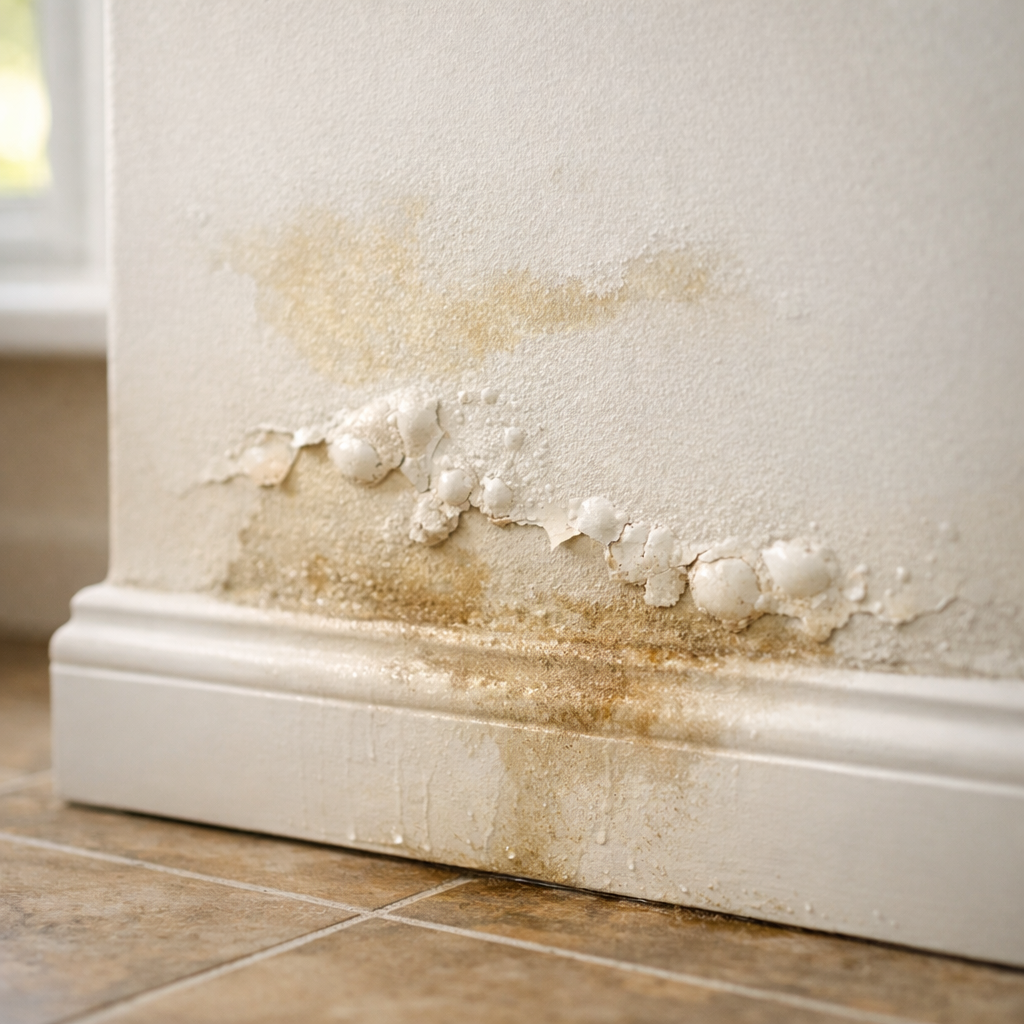
Brown or yellowish stains on a ceiling or wall are one of the more obvious plumbing warning signs, and yet they’re frequently left unaddressed because they’re not causing any immediate problem. The stain is dry. The area feels solid. People assume the leak fixed itself, or that it was a one-off from rain getting in.
Occasionally that’s true. But more often, what you’re looking at is the dried residue of water that’s still finding its way somewhere it shouldn’t be. The surface might feel dry because the most recent event happened days ago and the wall has had time to dry on the outside — while remaining damp further in.
Any ceiling stain directly below a bathroom, laundry or kitchen on the floor above deserves investigation. Same goes for wall stains near plumbing fixtures, and patches of paint that’s bubbling or peeling without an obvious cause. These aren’t cosmetic problems. They’re indicators of water that needs to be traced to its source.
6. Your Water Bills Have Gone Up Without Explanation
Sydney water bills vary across the year, but the variation tends to follow predictable patterns — gardens needing more water in summer, for example. A bill that jumps significantly outside those normal swings is worth questioning.
A running toilet is one of the most common causes of unexplained water loss in homes, and it’s surprisingly easy to miss. The leak often happens through the overflow tube inside the cistern, where water runs silently into the bowl. You’re not hearing a drip or seeing a puddle — the water is just quietly going down the drain. A single running toilet can add hundreds of litres to your daily usage.
The simple test: put a few drops of food colouring into the cistern and wait 15 minutes without flushing. If colour appears in the bowl, the cistern seal is leaking.
For larger unexplained increases, the problem may be in the supply line between the meter and the house — an area that’s often buried and out of sight. Turning off every tap and appliance in the home and checking whether the water meter is still turning is a quick way to confirm whether there’s a leak somewhere in the supply line.
7. You Can Hear Running Water When Nothing Is On
The house is quiet. Taps are off. Dishwasher and washing machine aren’t running. And there’s still a faint sound of water moving through the walls.
This is one of the clearest signs of an active leak somewhere in the system. Water under pressure, finding a path it shouldn’t be taking, makes noise — a soft hissing, trickling or gurgling that you’ll hear most clearly when the house is quiet and your ear is close to a wall near a pipe run.
Don’t ignore it. This is the sound of water going somewhere in your home’s structure. The longer it continues, the more damage accumulates in places you can’t see.
A Note on Timing
One thing worth understanding about plumbing problems is that they follow a cost curve. The earlier a problem is caught, the cheaper and less disruptive it is to fix. A leaking seal around a toilet base costs very little to replace. Left for a year, the water damage to the subfloor underneath can require the toilet to be removed, the damaged floor material pulled out and replaced, and the area treated for mould — a job that costs many times more than the original repair.
The same principle applies across nearly every plumbing issue on this list. Finding a small problem before it becomes a large one is almost always a matter of paying attention to the signs early.
If you’re noticing any of the above in your home and you’re not sure what’s causing it, the right call is to get a licensed plumber to take a look before making assumptions — in either direction.
About the Author: This post was contributed by the team at AIM Local, a licensed trade services company providing plumbing, electrical and roofing services to homeowners across Sydney, the Central Coast and Newcastle. AIM Local operates 24/7 with upfront fixed pricing and a 90-minute response commitment. Visit aimlocal.com.au or call 1800 187 168.