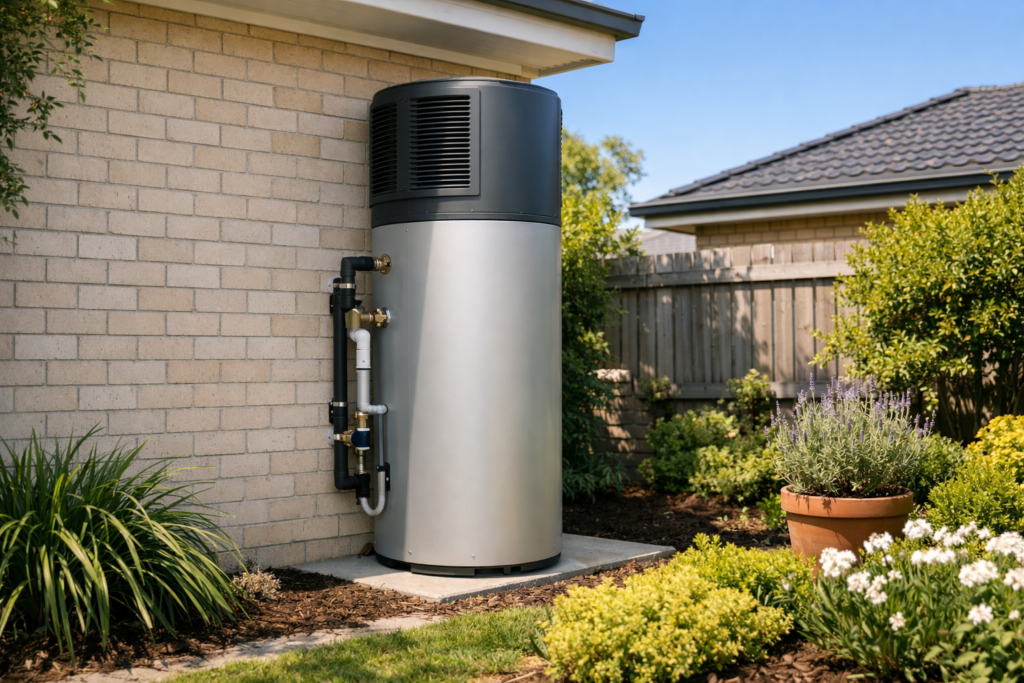
Switching to a heat pump hot water system keeps coming up in conversations about household energy, and the interest makes sense. The technology has matured significantly over the last decade, the government rebate situation has improved, and there are now enough Australian-designed systems on the market that the early adopter risk is largely gone.
But there’s still a lot of noise around the topic — vague claims about energy savings, brand comparisons that don’t reflect Australian conditions, and installations that weren’t quite right for the property. This is a straightforward look at how these systems actually work, where they make sense, and what to watch out for.
What a heat pump actually does differently
A standard electric hot water tank has a heating element inside it — essentially a big kettle element that sits in the water and draws power directly to heat it. Simple, reliable, and completely dependent on the electricity it consumes. When power prices go up, your hot water bill goes up at the same rate.
A heat pump works on a completely different principle. It pulls heat from the surrounding air — even reasonably cool air — and transfers that heat into the water. The electricity it uses runs a compressor and a fan, not a direct heating element. The result is that for every 1 kilowatt-hour of electricity the system uses, it delivers roughly 3–4 kWh of heat energy to the water.
That ratio — called the coefficient of performance, or COP — is what makes the running cost numbers look so different. You’re not paying for all the energy that heats the water. You’re paying for the energy to move existing heat from the air into the tank.
The key thing to understand is that a heat pump doesn’t generate heat — it moves heat that already exists in the air. That distinction is why energy consumption drops so significantly compared to a direct element system, regardless of which brand or model you choose.
Government rebates that apply in NSW
This is worth understanding before you get a quote, because how rebates work in practice differs from how they’re often described online.
Small-scale Technology Certificates (STCs)
Heat pump hot water systems are eligible for STCs under the federal Renewable Energy Target. In practical terms this means a discount applied directly at the point of sale — your installer deducts the rebate value from the quoted price. You do not apply for it separately or wait for a payment after installation. The value depends on your postcode and system size. Ask your installer to confirm the STC amount before you commit and check it’s already factored into the quote as a line item.
NSW Energy Savings Scheme
Some heat pump installations also qualify for additional incentives under the NSW Energy Savings Scheme. Eligibility depends on the specific model and your electricity retailer. Not every installation qualifies, and the rules change periodically, so it’s worth a direct question to your installer rather than assuming it applies.
What to watch for
A legitimate rebate is always deducted before you pay, not promised as a cheque later. If a quote doesn’t clearly show the STC deduction as a separate line, ask for it to be itemised. It’s also worth confirming that the installer is an authorised STC agent — the vast majority of licensed plumbers are, but worth a quick check.
Where it actually makes sense — and where it doesn’t
Heat pumps are not the right answer for every situation, and any installer who tells you otherwise is not being straight with you.
Good fit:
- Households of 3 or more people with high daily hot water usage
- Properties replacing an existing electric storage system where no new gas connection is needed
- Homes with enough outdoor or semi-enclosed space around the unit — roughly 1 metre of clearance on all sides for adequate airflow
- Properties in Sydney’s climate zone, where ambient air temperatures rarely drop below 5°C for extended periods (heat pumps lose efficiency in sustained cold weather)
- Households on a controlled load electricity tariff who can schedule the system to run during off-peak hours
Less ideal:
- Very small households of 1–2 people with low daily hot water usage — the energy savings are smaller and may not justify the switch from a newer electric system
- Properties with no suitable outdoor installation location — heat pumps need airflow and produce some noise (around 45–50 decibels), which matters if the only location is directly outside a bedroom window
- Situations where a like-for-like emergency replacement is needed today and there’s no time for the slightly longer installation process
- Homes already on gas with a well-functioning continuous-flow system — the running cost comparison against gas is less clear-cut than against electric, and adding a heat pump means adding electricity dependence alongside an existing gas setup
What the installation process actually involves
A heat pump installation is a bit more involved than swapping out an electric tank, which is worth knowing before you book.
The outdoor unit — which looks similar to a reverse-cycle air conditioner compressor — needs a solid, level surface. In most cases this means a concrete pad, either existing or newly poured. The plumber connects the refrigerant circuit between the outdoor unit and the tank, runs the new electrical connections, and sets the controller. Most installations take half a day to a full day.
The tank itself is usually floor-standing and sits in the same position as your existing hot water unit. A 270–315 litre tank is the most common size for a family of four in Sydney. Some systems combine the compressor and tank in a single unit, which simplifies installation but limits where you can put it.
One thing to check before committing: your electrical switchboard. Heat pumps draw more current on startup than a standard tank element. Older switchboards occasionally need a circuit upgrade, which adds cost. A good installer checks this during the quote process and tells you upfront if it applies to your property.
The brands worth knowing about
The Australian heat pump market has expanded a lot in the last few years, and the range is now wide enough that brand selection matters more than it used to.
Sanden and Reclaim Energy are the two Australian-designed systems built specifically for local conditions. They use CO₂ as the refrigerant rather than the HFCs used in older European designs, which gives better performance at lower ambient temperatures and more stable year-round operation in Sydney’s climate. Both carry strong manufacturer warranties — check the specific terms with your installer as these vary by model.
iStore and Stiebel Eltron are the other names most commonly installed by Sydney plumbers. iStore is an Australian brand built for local conditions with a solid service network. Stiebel Eltron is a German manufacturer with a strong reliability record.
Cheaper imported units are available — some sold direct online — but the support network is patchy and parts availability can be a problem after a few years. For a system you’re expecting to run for a decade, the brand and installer support matter as much as the unit price.
The bottom line
If you’re replacing an electric hot water system and your home has a suitable outdoor space, a heat pump is almost certainly the better long-term decision. The upfront cost is real, but after rebates and accounting for running costs, most Sydney households are ahead within 2–3 years and significantly ahead over the system’s life.
The situation is less clear-cut if you’re on gas, have a small household, or face site constraints that complicate installation. In those cases, it’s worth getting a proper assessment rather than assuming one way or the other.
Infinity Hot Water installs heat pump systems across Sydney, the Central Coast, and Newcastle — all brands, written quotes, and STC rebates deducted at point of sale. If you’re not sure whether a heat pump suits your property, a site assessment will give you a straight answer based on your actual setup.