For years, the SEO software market has had a fairly simple structure.
If you wanted serious keyword research, competitor analysis, backlink data, rank tracking and technical SEO tools, you generally went to platforms such as Ahrefs or Semrush.
They are powerful products.
They are also expensive products.
And that creates an interesting gap.
What happens when someone needs good SEO data but does not want to spend $100 or more every month on an enterprise-style SEO platform?
That’s the problem Ben Senescu, a software engineer rather than a traditional SEO professional, decided to explore with OpenSEO.
His starting point was surprisingly simple.
He wanted to do keyword research for his own projects. Then he looked at the pricing and complexity of existing tools and wondered whether there was a better way.
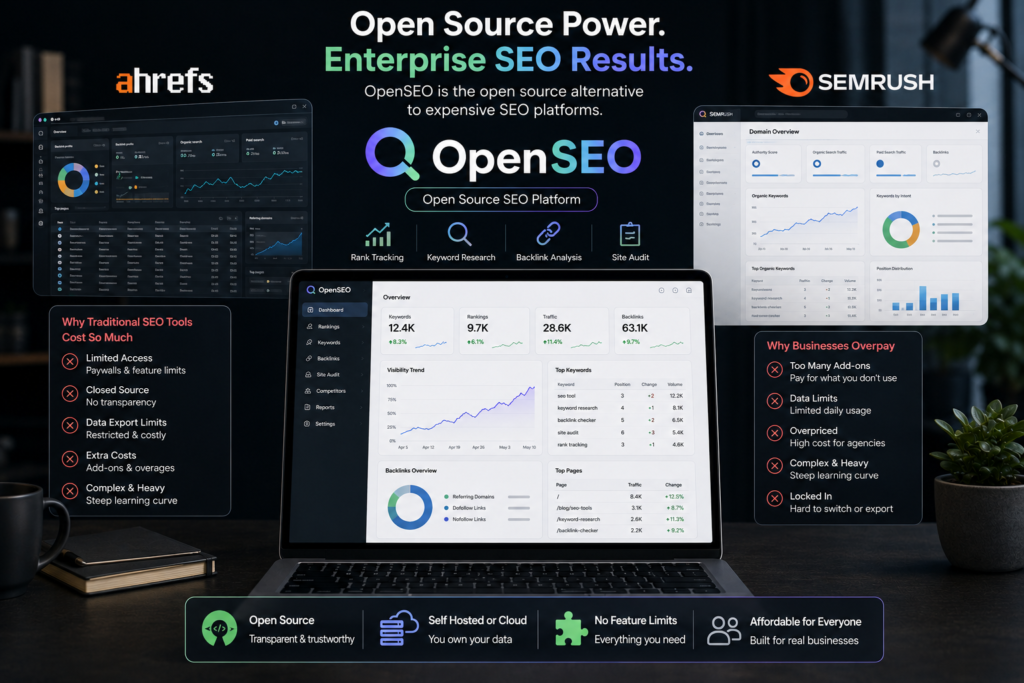
That question eventually became OpenSEO, an open-source SEO platform positioned as an alternative to tools such as Ahrefs and Semrush.
And the interesting part isn’t simply that another SEO tool has entered the market.
It’s the model behind it.
OpenSEO Is Trying to Change How SEO Tools Are Bought
The traditional SEO software model is subscription-first.
You choose a plan.
You pay every month.
You get a certain number of keywords, projects, reports, crawls, exports or credits depending on the package.
Whether you use all of those resources or not, the subscription continues.
Ben’s argument is that this doesn’t make much sense for everyone.
His own comparison points to current prices around $139 per month for Semrush, $129 for Ahrefs Lite, $99 for Moz Standard and $24 for Keysearch Starter. OpenSEO takes a different approach: its hosted base plan starts at $10 per month and gives users $10 of usage credits, with additional usage available when needed.
The difference is important.
OpenSEO isn’t simply saying:
“We are a cheaper Ahrefs.”
It is saying:
“Why should you pay for a large SEO platform when you only need a small part of it?”
That is a much more interesting proposition.
What Exactly Is OpenSEO?
OpenSEO describes itself as an open-source alternative to Semrush and Ahrefs.
The platform brings several common SEO workflows into one workspace:
- Keyword research
- Live SERP research
- Competitor research
- Domain analysis
- Backlink analysis
- Rank tracking
- Technical site audits
- AI visibility
- Google Search Console data
- AI agent integrations through MCP
The GitHub repository currently describes it as an all-in-one SEO tool for both humans and AI agents. It also offers a modern interface focused on individual workflows instead of trying to replicate every feature found in large enterprise SEO suites.
That last part matters.
A founder who wants to research a few keywords doesn’t necessarily need 50 different dashboards.
A developer who wants to understand competitor search demand doesn’t necessarily need an enterprise SEO workflow.
A freelancer managing a handful of small businesses may not need to pay for a huge monthly keyword quota.
OpenSEO is targeting that gap.
The Open Source Part Is More Important Than It Sounds
Open source isn’t just being used as a marketing label here.
The code is publicly available on GitHub under the OpenSEO repository, and the project can be self-hosted. The repository currently has thousands of stars and more than a thousand forks, showing significant early interest from the developer community.
Users can run the software themselves using Docker or deploy it through Cloudflare.
That changes the relationship between the customer and the software.
You aren’t completely dependent on a vendor’s dashboard.
You can inspect the code.
You can contribute.
You can modify it.
You can build your own workflows.
And if you’re technical enough, you can essentially turn OpenSEO into your own SEO platform.
That’s a very different proposition from signing up for another closed SaaS product.
But Open Source Does Not Mean Free SEO Data
This is where the story gets more interesting.
The software may be open source, but SEO data is not free.
OpenSEO uses DataForSEO for its keyword, backlink and other SEO data. When you self-host the application, you bring your own DataForSEO API key and pay DataForSEO directly.
The hosted version handles those requests for you and adds a margin to the underlying data cost. OpenSEO’s documentation currently says its hosted service adds 28% to DataForSEO request costs.
This is an important distinction.
The code is open.
The data infrastructure still costs money.
And that explains why building a genuinely useful open-source alternative to Ahrefs isn’t as simple as putting a nice interface on GitHub.
The interface can be open.
The underlying search data still has a bill attached to it.
Why Data Matters More Than the Interface
This is probably the biggest issue OpenSEO has to solve.
SEO professionals don’t buy Ahrefs or Semrush because the buttons are pretty.
They buy access to data.
Keyword volume.
Ranking information.
Backlinks.
Competitor keywords.
SERPs.
Historical trends.
Traffic estimates.
Content gaps.
The interface is simply how you consume that data.
OpenSEO itself acknowledges this indirectly through its DataForSEO architecture.
Product Hunt users have also raised questions about the source and quality of the underlying keyword and backlink data. Ben has said OpenSEO uses DataForSEO, which he describes as a strong third-party provider for backlink and keyword data.
But there is an important caveat here.
A third-party data provider can make a product affordable, but it also means OpenSEO doesn’t own the entire data moat.
That’s something users should understand before comparing it directly with mature platforms.
And There Is Already Some Tough Feedback
One SEO professional with more than 20 years in the industry praised the pricing and positioning but raised a serious concern about OpenSEO’s keyword results.
The criticism was that the tool wasn’t surfacing enough short-tail keywords in the US market and was even weaker for smaller markets.
The suggestion was that if OpenSEO could improve its keyword coverage, there could be a very large market for a product priced somewhere between $9 and $49 per month.
That criticism is worth paying attention to.
Not because it proves OpenSEO has poor data.
It doesn’t.
It is one person’s experience and needs to be tested independently.
But because it highlights the central challenge for OpenSEO:
Affordable SEO software is easy to understand. Affordable, reliable SEO data is much harder.
If the data isn’t good enough, the low price stops being an advantage.
OpenSEO’s Biggest Opportunity May Not Be Professional SEOs
This is where Ben’s story gets particularly interesting.
The obvious customer seems to be an SEO professional.
But according to the discussion around the product, that isn’t necessarily the biggest opportunity.
There are thousands of founders, developers, freelancers and small businesses who need SEO data but never become serious Ahrefs or Semrush customers.
Why?
Because the barrier isn’t necessarily that they don’t care about SEO.
The barrier is that the tools feel too expensive and too complicated.
A founder might want to know:
“Which keywords should I target?”
A developer might want to know:
“Which pages bring my competitor organic traffic?”
A SaaS founder might want to know:
“What are people searching for around this problem?”
A freelancer might need to check rankings for five clients.
None of these users necessarily needs a giant enterprise SEO suite.
They just need the answer.
That is the market OpenSEO can potentially unlock.
The $99 Ceiling
This is where the podcast discussion around the “$99 ceiling” becomes interesting.
For many small businesses and solo operators, $99 isn’t just another SaaS subscription.
It’s a psychological boundary.
Below that number, a tool can feel like something you can experiment with.
Above it, the buyer starts asking:
“How often am I actually going to use this?”
“Can I justify another monthly subscription?”
“Could I just hire someone?”
“Could I use ChatGPT instead?”
That creates an enormous group of potential SEO users who are technically interested in SEO but economically priced out of traditional tools.
OpenSEO doesn’t necessarily need to take every Ahrefs customer.
It may be more valuable if it creates a new category of customer.
People who previously didn’t use professional SEO software at all.
AI Changes the Equation Again
This is probably the most important part of OpenSEO’s long-term opportunity.
AI can generate SEO recommendations very easily.
Ask an AI:
“What keywords should I target?”
It can give you an answer.
The problem is that the answer may be based on general knowledge rather than actual search data.
That’s where things get dangerous.
An AI can sound extremely confident while giving you a completely useless keyword strategy.
Give the AI real keyword volume, SERP data, competitor rankings and backlink information, and the quality of the conversation changes.
Instead of:
“Here are some keywords you could consider.”
You can get:
“These keywords have this search demand, these competitors rank for them, this type of page currently dominates the SERP, and these are the gaps worth investigating.”
That’s a much more useful workflow.
OpenSEO is designed around exactly this idea.
OpenSEO and MCP Could Be the Bigger Story
MCP, or Model Context Protocol, changes how SEO tools can interact with AI agents.
Instead of manually exporting data from an SEO platform and pasting it into an AI tool, an agent can potentially access the SEO data directly.
OpenSEO exposes an MCP server that can connect with tools such as Claude, Cursor, Codex, ChatGPT and other MCP clients. Its documentation also provides agent skills designed to guide AI through SEO workflows.
That creates a different type of SEO software.
The interface doesn’t necessarily have to be the final destination.
The SEO platform can become the data layer underneath an AI workflow.
Imagine asking an agent:
“Find keywords where my competitors rank on page one but I don’t.”
The agent gets the data.
Or:
“Find pages on my site ranking between positions 8 and 20 that have strong business intent.”
The agent pulls the rankings.
Or:
“Compare my backlink profile with these three competitors and identify the biggest gaps.”
Again, the agent doesn’t have to guess.
It can work from actual data.
That’s where OpenSEO could become much more than a cheaper SEO dashboard.
AI Visibility Is Another Interesting Layer
Traditional SEO tells you where your website appears in search engines.
AI visibility asks a different question:
What does an AI system say about your brand when someone asks about your category?
OpenSEO includes AI visibility among its SEO workflows, and Ben has specifically argued that AI visibility should become part of the core product rather than another expensive add-on.
That’s an important direction.
As people increasingly use ChatGPT and other AI systems for research, marketers will want to understand:
- Is my brand mentioned?
- Which prompts trigger a mention?
- Which competitors are being recommended?
- What sources are AI systems citing?
- How frequently does my brand appear?
- Is the information accurate?
- Are competitors dominating the conversation?
Traditional rank tracking doesn’t answer those questions.
SEO software will increasingly need to cover both search visibility and AI visibility.
OpenSEO Is Also a Response to “Vibe Coding”
There’s another interesting cultural shift behind this project.
Developers are increasingly using AI coding tools to build their own internal software.
Instead of thinking:
“I need an SEO platform.”
They can think:
“I need a specific SEO workflow.”
Then build it.
OpenSEO fits naturally into that world because the project is open source and designed to be modified.
The GitHub repository even positions the product around the ability to fork it and build your own custom tool.
That’s powerful for developers.
A developer could theoretically take the existing foundation and build:
- A niche keyword research tool
- An internal agency SEO dashboard
- A programmatic SEO research system
- An AI content planning workflow
- A competitor monitoring tool
- A custom reporting interface
The opportunity isn’t only to use OpenSEO.
It is to build on top of it.
But There Are Downsides
OpenSEO isn’t automatically the right choice for everyone.
There are some very real limitations to consider.
1. Data dependency
OpenSEO depends heavily on DataForSEO for its underlying SEO data.
That means your experience ultimately depends partly on the quality, coverage and pricing of that data source.
2. It isn’t necessarily an Ahrefs replacement for every workflow
A professional SEO agency with years of historical projects and complex enterprise workflows may still find mature platforms more convenient.
OpenSEO is trying to solve a different problem.
3. Self-hosting requires technical knowledge
Docker, Cloudflare and API keys are straightforward for developers.
They aren’t necessarily straightforward for a small business owner.
The hosted version solves some of that problem, but then you move back toward paying for managed infrastructure.
4. Usage still costs money
Pay-as-you-go is attractive when usage is low.
But heavy users can still accumulate meaningful data costs.
The lower subscription doesn’t magically make keyword and backlink data free.
5. Data coverage needs to prove itself
This is perhaps the biggest question.
If OpenSEO wants professional SEOs to move away from established tools, its data has to hold up under serious testing.
A beautiful interface won’t compensate for missing keywords or unreliable competitor data.
Where OpenSEO Could Win
I don’t think OpenSEO needs to beat Ahrefs at everything.
That would be an enormous undertaking.
There is a much more realistic path.
Own the users who don’t want Ahrefs.
That includes:
Founders.
Indie hackers.
Developers.
Freelancers.
Small agencies.
Small businesses.
Content creators.
Early-stage SaaS companies.
Technical marketers.
AI-native teams.
These users don’t necessarily need 15 years of historical data or every enterprise feature.
They need useful information without a giant monthly commitment.
That is a very large market.
The Agency Opportunity Is Interesting Too
SEO agencies could potentially use OpenSEO in a different way.
Instead of buying expensive seats for every person, an agency could self-host the platform and build internal workflows around it.
For example:
A client enters the agency.
The agency runs keyword research.
Competitor data is collected.
Backlinks are analysed.
Rank tracking is configured.
Technical audits are run.
Then an AI agent uses the data to generate research summaries or identify opportunities.
The agency’s SEO strategist still makes the decisions.
The software simply reduces the amount of manual work required to collect and organize information.
That’s probably a healthier role for AI in SEO.
Not replacing the strategist.
Giving the strategist better access to information.
What Happens to Ahrefs and Semrush?
OpenSEO doesn’t mean Ahrefs or Semrush suddenly become irrelevant.
Those products have enormous advantages.
They have mature datasets.
Established brands.
Large customer bases.
Years of product development.
Extensive integrations.
Advanced workflows.
Professional support.
And users who are already deeply embedded in their platforms.
OpenSEO is unlikely to replace them overnight.
But it doesn’t have to.
The real pressure is at the bottom of the market.
If a founder can spend $10 instead of $129 to get enough SEO data to make good decisions, that changes the economics of SEO software.
And if that founder eventually grows into a larger company, they may already have a workflow built around OpenSEO.
That’s how a small product can eventually become a serious competitor.
The Future May Not Be More SEO Dashboards
This may be the most interesting lesson from OpenSEO.
The future of SEO software probably isn’t another dashboard with 50 tabs.
We already have plenty of those.
The bigger opportunity is software that understands what you are trying to accomplish and brings the relevant data to you.
Imagine opening your AI coding or marketing agent and saying:
“Find me three content opportunities that have real search demand, weak competition, commercial intent and strong relevance to my product.”
The system researches the market.
It checks competitors.
It looks at SERPs.
It evaluates your existing pages.
It checks Search Console.
Then it gives you a shortlist.
That’s much closer to where SEO software is heading.
The interface becomes less important.
The data and the reasoning layer become more important.
OpenSEO FAQ
Is OpenSEO really free?
The software is open source and can be self-hosted. However, SEO data still costs money because OpenSEO relies on DataForSEO for much of its data. The hosted version currently starts at $10 per month and includes usage credits.
Is OpenSEO a replacement for Ahrefs or Semrush?
It can be an alternative, particularly for founders, freelancers, developers and small teams. But it shouldn’t automatically be considered a complete one-to-one replacement for every advanced workflow in mature enterprise SEO platforms.
Does OpenSEO provide keyword research?
Yes. Its keyword workflow includes keyword ideas, search volume, difficulty, CPC, intent signals and live SERP results.
Can OpenSEO track rankings?
Yes. Rank tracking is one of its core workflows, with support for locations, desktop and mobile results, ranking URLs, movement and SERP features.
Can it analyse backlinks?
Yes. OpenSEO includes backlink analysis covering referring domains, target URLs and signals such as rank, spam, broken, lost and nofollow links.
Can OpenSEO perform technical SEO audits?
Yes. Its audit workflow can crawl pages and inspect items including status codes, titles, meta descriptions, headings, indexability, image alt coverage, links and response time, with optional Lighthouse findings.
Does OpenSEO work with AI?
Yes. AI integration is one of its major differentiators. OpenSEO provides MCP access for AI clients including Claude, Cursor, Codex and ChatGPT, allowing agents to work with SEO and Search Console data.
Does OpenSEO work with Google Search Console?
Yes. OpenSEO can connect to Search Console using read-only access. Agents can read information such as clicks, impressions, CTR, position and URL inspection data, but they cannot modify the connected account.
Do I need to be a developer to use OpenSEO?
Not necessarily.
The hosted version is designed to be easier to use. Self-hosting, however, is much more suitable for people who are comfortable with Docker, Cloudflare and API configuration.
What is the biggest risk for OpenSEO?
Data quality and coverage.
The pricing model is attractive. The open-source approach is attractive. The AI integration is interesting.
But professional SEOs ultimately need to trust the data.
If OpenSEO can consistently provide reliable keyword, SERP, backlink and competitor information at a fraction of traditional platform costs, the opportunity is significant.
The Bigger Lesson
What I find most interesting about OpenSEO isn’t that someone built another SEO tool.
It’s that someone outside traditional SEO looked at the market and asked a very simple question:
Why does SEO software have to work this way?
That’s often where interesting products come from.
Not from someone trying to make a slightly better version of an existing product.
But from someone who doesn’t accept the existing assumptions.
SEO software has spent years becoming more powerful, more complex and more expensive.
OpenSEO is betting that the next generation may want something different:
Less software.
Better data.
More control.
Pay for what you actually use.
And increasingly, let an AI agent work with the data instead of forcing a human to dig through another dashboard.
Whether OpenSEO becomes a serious challenger to Ahrefs and Semrush remains to be seen.
But the market it is targeting is real.
There are millions of people who need SEO data but have never paid $100 or more a month for an SEO platform.
If OpenSEO can give those people reliable data, a simple experience and useful AI workflows, it doesn’t need to win the entire SEO market.
It just needs to make the old pricing model feel unnecessary.
And that could be a much bigger disruption than another feature added to an SEO dashboard.