There’s a particular kind of tired that comes from staring at a screen for the tenth hour in a row. It’s not physical exhaustion exactly. It’s more like a dulling, the sense that hours have passed and nothing actually happened. A lot of people have been living with that feeling for years now, and it’s starting to show up in how they choose to spend their evenings and weekends.
Across the country, that fatigue is quietly rewriting the entertainment industry. People aren’t just looking for something to watch anymore. They want something to walk into, touch, react to, and remember in their body, not just their feed. That shift is behind one of the more interesting cultural changes happening right now: the rise of immersive and hybrid experiences.
Screens Got Us Here, and Now They’re Pushing Us Away
It’s worth pausing on the irony. Streaming services, social apps, and virtual events gave people more entertainment options than any previous generation ever had, all available without leaving the couch. For a while, that felt like enough. Then it started to feel like too much of the same thing.
Endless scrolling and passive watching have a way of blending together after a certain point. One show looks like the next. One feed looks like the last one. There’s a flatness to consuming everything through a rectangle of glass, no matter how good the content is.
What people are craving instead is friction, in a good way. The kind of evening where you have to show up somewhere, move through a space, make small choices, and talk to strangers or friends in the same room. That’s not a rejection of technology. It’s a request for technology to step aside and let real, physical moments take the lead again.
What Counts as an Immersive Experience Now
The term gets used loosely, so it helps to break down what’s actually happening on the ground.
Immersive events put the audience inside the story instead of in front of it. Think of a warehouse transformed into a walkthrough world, where guests move room to room and the environment reacts to them through lighting, sound, and sometimes performers weaving through the crowd. There’s no fixed seat and no single vantage point. Everyone experiences a slightly different version of the same event depending on where they wander and what they choose to interact with.
Interactive pop-ups take a similar idea and shrink it down. A weekend installation in a city might invite visitors to touch, build, taste, or physically participate rather than just look. These events tend to be built for sharing in the moment, but the appeal isn’t really about documentation. It’s about giving people something worth doing with their hands and attention for an hour or two.
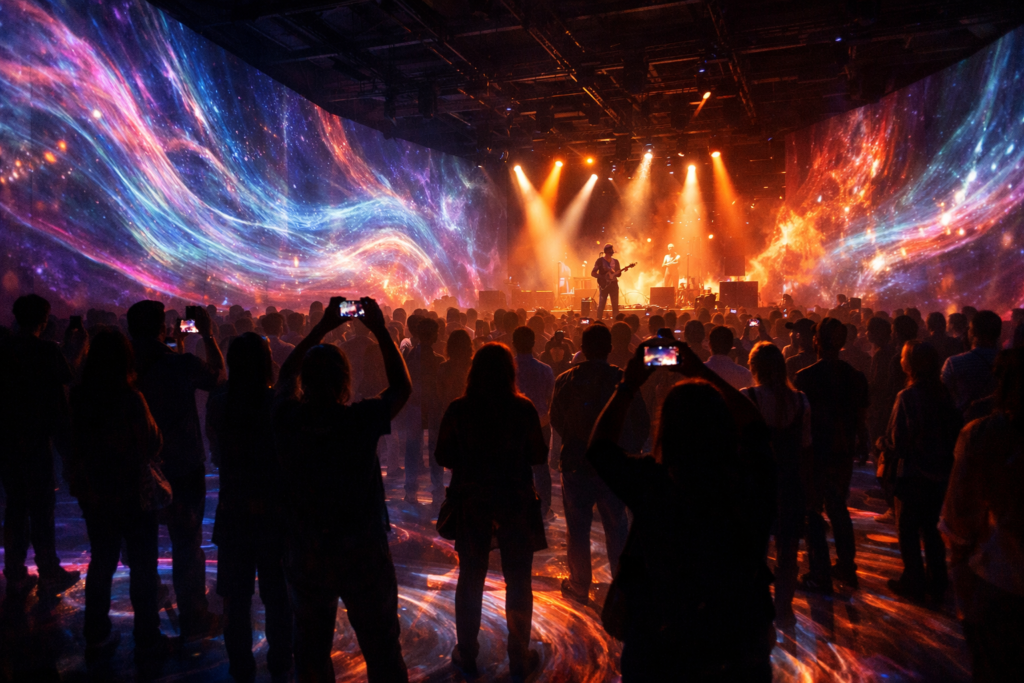
Hybrid festivals blend the traditional and the digital rather than replacing one with the other. A live outdoor concert might use projection mapping to turn a stage into a shifting visual landscape. A gallery opening might let attendees view physical art alongside a digital layer only visible through a phone camera. The point isn’t to make the real thing feel less real. It’s to add a second layer of storytelling on top of it, one that couldn’t exist without both the physical space and the digital tool working together.
Where Live Music Comes In
Concerts have always been one of the most physical, communal forms of entertainment, so it makes sense they’ve become a major testing ground for this shift. Artists and event producers are increasingly layering augmented visuals directly into live shows, so that what an audience sees through a phone screen or a pair of AR glasses adds a second dimension to what’s happening on stage.
Picture a singer performing under normal stage lighting, while anyone viewing through a compatible device sees animated visuals swirling around the performer in real time, synced to the music. Or a festival stage where the crowd can trigger visual effects collectively through movement or sound, turning thousands of individual audience members into part of the show itself.
This isn’t about replacing the live element with digital spectacle. The performers are still there, the sound is still live, the sweat and the crowd energy are still real. The technology is layered on top as an enhancement, not a substitute. That distinction matters, because the moment a live show starts feeling like a screen with extra steps, it loses the exact thing people came for.
Why This Is Landing With Audiences Right Now
A few forces are converging to make this the right moment for immersive and hybrid formats to take off.
There’s a strong appetite for novelty that photos and video alone can’t satisfy anymore. People have seen enough polished content online that a beautifully shot video of an event no longer feels special on its own. Being there, physically, has become the differentiator. An experience that can only be understood by attending in person carries a kind of value that passive content can’t replicate.
There’s also a generational shift in what people value spending money on. Rather than accumulating more physical belongings, a lot of younger adults are prioritizing experiences and memories, and they’re willing to pay a premium for something that feels one of a kind. An event that only happens once, in one place, with a limited run, taps directly into that mindset.
Social connection plays a role too. After a long stretch of isolated, screen-based routines, shared physical spaces feel more valuable than they used to. Standing shoulder to shoulder with strangers reacting to the same unexpected moment creates a kind of bonding that a group chat never quite manages.
Finally, the technology itself has simply gotten easier to use. Augmented reality tools that once required bulky headsets or specialized equipment can now run through an ordinary phone camera. Lowering that barrier to entry means event producers can experiment with these layered experiences without needing every attendee to own expensive gear.
Also read: The Great Unplugging: Why Digital Privilege Is Becoming America’s New Status Symbol
What This Means for the Future of Entertainment
The venues and formats built around this shift are likely to keep multiplying. Expect more temporary, limited-run spaces designed specifically for one immersive concept rather than permanent theaters built for repeat use. Expect festivals to keep blending physical stages with digital layers as the tools become cheaper and more reliable. Expect concerts to lean further into audience participation, using technology to make each person in the crowd feel like part of the performance rather than a spectator watching from a distance.
None of this spells the end of traditional entertainment. People will still watch movies at home and stream music on their commute. But the middle ground, the space between fully passive digital consumption and fully unplugged real-world activity, is where a lot of the energy and investment is heading right now.
The core appeal is simple, even if the technology behind it isn’t. After years of experiencing life through a screen, people want proof that they were somewhere, that something actually happened to them, and that it couldn’t have happened anywhere else. Immersive and hybrid experiences are built entirely around delivering that proof, one room, one stage, and one unforgettable night at a time.