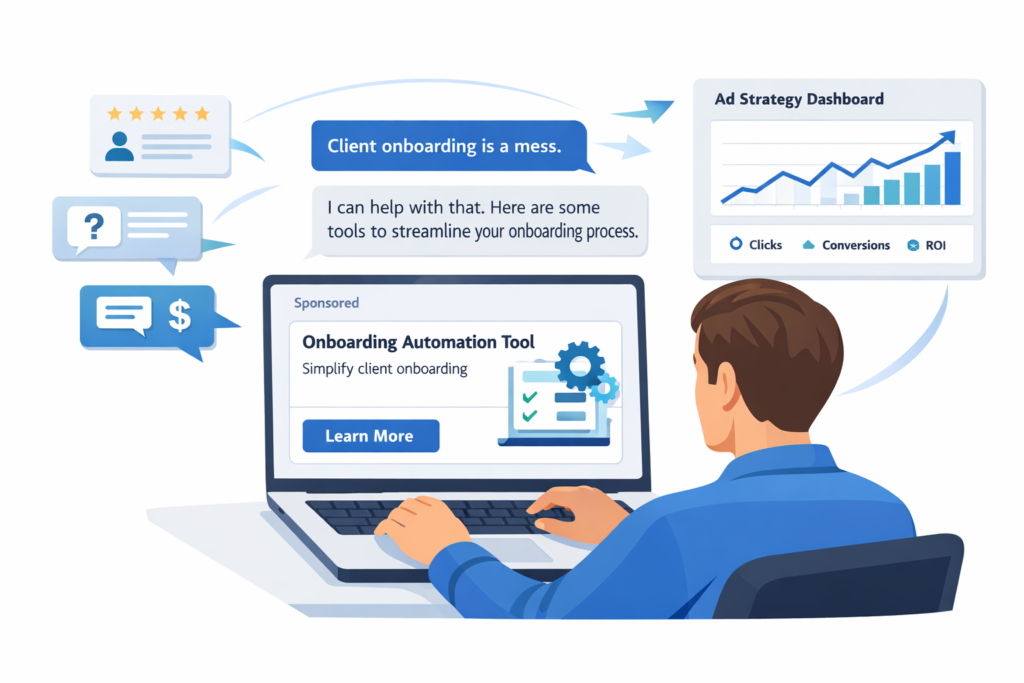
Most marketers hear “ChatGPT Ads” and immediately compare them with Google Ads.
That comparison makes sense, but it also creates the wrong expectations.
Google Ads are built around searches. ChatGPT Ads are built around conversations.
That sounds like a small difference, but it changes how businesses should think about advertising.
Imagine two people looking for project management software.
On Google, someone might search:
“Best project management software”
On ChatGPT, the conversation looks very different.
“I run a small agency. We manage everything in spreadsheets, clients keep asking for updates, and my team misses deadlines. What’s the best way to organize projects?”
The second example contains much more than a keyword.
It tells a story.
It reveals the user’s business, their frustration, their current process, and what they’re trying to achieve.
That is the biggest shift with ChatGPT Ads.
Ads Match Conversations, Not Just Keywords
Traditional advertising focuses on matching search terms.
With ChatGPT, the context of the entire conversation matters.
If someone spends several messages discussing hiring challenges, client onboarding, or slow website performance, the platform understands the broader problem before showing a relevant sponsored placement.
This means marketers need to stop thinking only about keywords and start listening to how customers naturally describe their problems.
Instead of targeting:
- CRM Software
- SEO Agency
- Accounting Tool
Think about phrases people actually use.
- “We’re losing leads.”
- “Our onboarding is a mess.”
- “Nobody can find our website.”
- “We’re wasting hours every week.”
Those are the conversations people are already having.
The User Already Received Advice
One of the biggest differences is timing.
On Google, your ad often appears before someone gets an answer.
On ChatGPT, the AI has already explained the problem and suggested possible solutions.
Now the user is looking for the next step.
That changes what your advertisement should do.
Don’t repeat what the AI already explained.
Instead, help the user take action.
For example, after ChatGPT explains ways to improve client onboarding, a project management platform could simply say:
Organize your entire onboarding process with ready-to-use templates. Start your free trial today.
Simple.
Direct.
Relevant.
Product Listings Can Appear Inside the Experience
For businesses selling physical products, ChatGPT can also surface actual product listings.
If someone asks for recommendations for office chairs, cameras, or laptops, sponsored product cards may appear separately from the assistant’s response.
The key point is that these are clearly marked as sponsored content.
The AI answer remains independent, while the advertisement offers a practical next step for users who are ready to explore products.
How Businesses Should Prepare
Even if ChatGPT Ads are still evolving, there are several things marketers can start doing today.
Build a Problem Library
Forget keyword spreadsheets for a moment.
Instead, collect real customer language.
Look through:
- Sales calls
- Support tickets
- Live chat transcripts
- Customer reviews
- Discovery meetings
These conversations reveal exactly how customers describe their challenges.
That language is far more valuable than polished marketing copy.
Speak Like Your Customers
If customers say,
“Our onboarding is chaos.”
Don’t rewrite it as,
“Enterprise workflow optimization.”
The first sentence feels real because it comes directly from users.
People trust language that sounds familiar.
Create Pages Around Problems
Many websites organize landing pages by products.
AI conversations often begin with problems instead.
Instead of sending every visitor to a general product page, create dedicated pages that answer specific challenges.
Examples include:
- How to simplify client onboarding
- How to reduce support requests
- How to improve team collaboration
- How to generate more qualified leads
Visitors feel understood when the page reflects the conversation they were just having.
Measure Business Results
As AI advertising grows, success won’t simply come from getting more clicks.
A smaller number of highly qualified visitors can easily outperform thousands of casual clicks.
The real metrics remain the same:
- Leads
- Sales
- Revenue
- Customer lifetime value
Traffic alone has never been the goal.
The Biggest Opportunity
The businesses that succeed with ChatGPT Ads probably won’t be the ones with the biggest advertising budgets.
They’ll be the ones that understand their customers better than anyone else.
Every support ticket, every sales call, every review, and every complaint contains valuable language.
That language tells you what people are struggling with.
And when your advertisement reflects those exact words, it feels less like an interruption and more like a helpful recommendation.
AI advertising isn’t replacing good marketing.
It’s rewarding businesses that truly understand their customers.
As conversations become the new starting point for discovery, listening may become one of the most valuable marketing skills of all.