Let me tell you something that’s been quietly bothering a lot of business owners over the past 18 months.
Their website traffic looks fine. Rankings are holding. The technical audit comes back clean. But the leads? They’ve slowed down. Enquiries that used to come in regularly are thinner than they were two years ago, and nobody can quite put a finger on why.
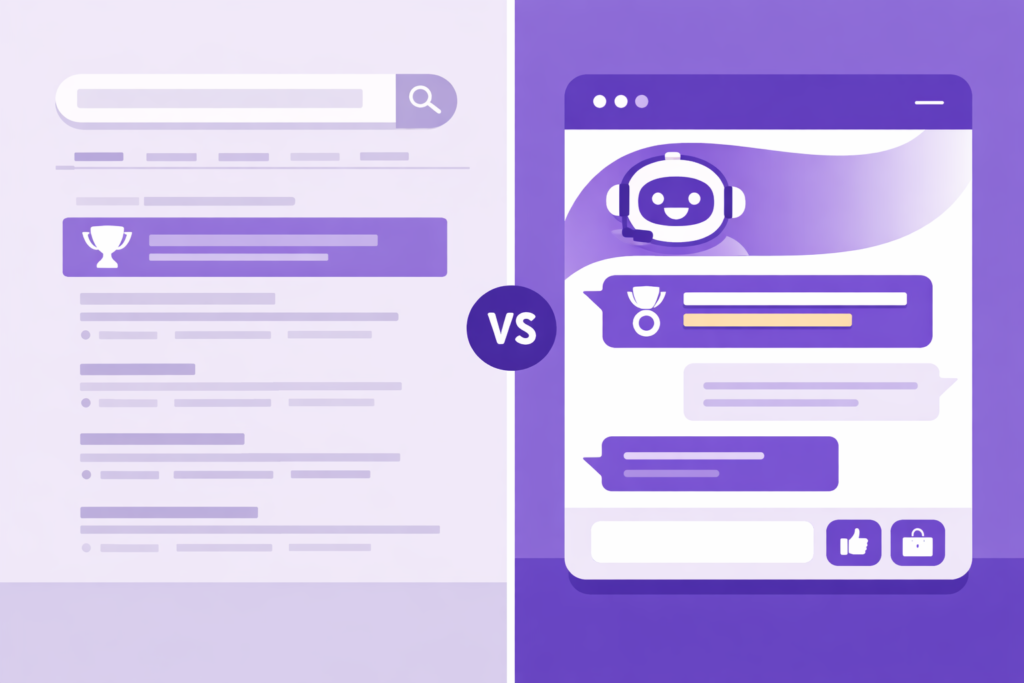
Here’s the thing most SEO agencies won’t tell you: your Google ranking and your actual discoverability are no longer the same thing.
The Way People Search Has Changed
Think about how you looked something up last week. If you’re like most people, there’s a decent chance you typed a question into ChatGPT, asked Gemini through Google, or fired something into Perplexity rather than scrolling through ten blue links. You got a direct answer. You didn’t click through to three different blog posts to piece together the information yourself.
That shift is happening at scale. Over 800 million people now use ChatGPT weekly. Gartner estimates that traditional search engine traffic will drop by roughly 25% by 2026 as AI assistants take over the information-gathering part of the buying journey. Google’s own AI Overviews now reshape how 84% of search results are presented before a user ever sees an organic listing.
The practical upshot: if an AI assistant doesn’t mention your brand when someone asks a question in your niche, you effectively don’t exist for that buyer. Even if you’re ranking number one on Google.
What Is AI SEO and Why Does It Work Differently
Traditional SEO is built around signals that search engines use to rank pages: backlinks, keyword density, page speed, title tags. It’s a system optimized for humans typing short queries into a box and then choosing which link to click.
AI SEO, sometimes called Generative Engine Optimisation (GEO) or Answer Engine Optimisation (AEO), works on a different logic entirely. Large language models like Claude, GPT-4, and Gemini don’t rank pages. They synthesise information and generate responses. They pull from training data, live web crawls, high-authority community sources like Reddit and Quora, and structured data on your site to decide which brands to mention, recommend, or cite when someone asks a question.
The metric that matters here isn’t your ranking position. It’s something called Share of Model (SoM): how frequently and how positively your brand comes up when AI models respond to questions relevant to your business.
The AI SEO tool breaks this down clearly with a free visibility checker that actually runs a real audit of your site across seven criteria, from whether AI bots can crawl your content to how visible your brand is on trusted external sources.
The Gap Between Ranking Well and Being Recommended
There’s a question on that page that cuts to the heart of it: “Your customers are asking AI about you. Do you like what it says?”
Most business owners have never thought to ask that. They’ve invested in Google rankings, maybe some content marketing, possibly a few backlinks. But they haven’t checked whether ChatGPT, when asked to recommend a service in their industry, is naming them or naming a competitor.
The reasons a well-ranked site can be invisible to AI models include things like:
No structured data. If your site doesn’t use JSON-LD schema markup, AI crawlers have a much harder time understanding what your business does, who it serves, and why it should be trusted. A site without schema is harder for a language model to categorise and cite confidently.
No llms.txt file. This is a newer standard, modelled after robots.txt, that gives AI scrapers direct instructions about which content to read and how to interpret it. Without it, models are essentially guessing what matters on your site.
Weak community footprint. AI models weight consensus heavily. If your brand isn’t being discussed on Reddit threads, referenced in Quora answers, or cited in industry publications, models have less evidence that you’re a credible authority worth recommending.
No entity-level clarity. AI models work with entities – distinct, well-defined concepts that they can connect to each other. If your brand isn’t clearly associated with specific industry entities (the services you provide, the problems you solve, the geography you serve), you’re harder to retrieve accurately.
What an AI SEO Audit Actually Looks At
The free audit tool on the AI SEO services page checks your site across seven specific signals:
- Can AI bots access your site? This covers your robots.txt file, whether you’ve blocked crawlers like GPTBot, and whether your sitemap is properly set up.
- Is your content AI-readable? Schema markup, heading structure, and whether your content is written in a way that’s easy to extract and cite.
- Site speed. Slow sites get crawled less thoroughly. This isn’t just a user experience issue.
- Mobile performance. Tied to overall technical health, which affects how thoroughly any crawler indexes your content.
- Search visibility. Your existing SEO strength, which has some overlap with AI discoverability, particularly for brand authority signals.
- Security. HTTPS, SSL, and general site credibility markers that AI crawlers factor into trustworthiness.
- Brand visibility on trusted sources. This is the big one that most businesses are missing, whether your brand is being discussed and cited outside your own website.
The Services Behind a Proper AI SEO Strategy
Getting cited by AI models isn’t a one-time fix. It’s an ongoing discipline that covers content, technical setup, and off-site authority building simultaneously.
A proper AI SEO engagement typically involves building out your entity architecture (making sure AI models can clearly understand who you are and what you do), fixing the technical gaps that prevent AI crawlers from accessing your content properly, seeding authentic mentions on high-authority community platforms, and tracking your Share of Model month-on-month so you can see the results in a concrete way.
There’s also a consultancy layer that’s often underestimated: training your content team to write in a way that AI models find citable. This isn’t about keyword stuffing or writing for bots. It’s about writing content that’s direct, factual, well-structured, and grounded in specific claims that a language model can extract and restate accurately.
Is This Worth Paying Attention to Now?
A fair question. If your leads are currently fine, should you care about AI visibility?
The short answer is that the shift is already well underway. Lead conversion rates from AI-referred traffic are tracking around three times higher than average, likely because someone who asks an AI assistant for a recommendation and then acts on it has already done their mental vetting through the conversation. They arrive pre-sold in a way that someone who found you through a search result does not.
The businesses building AI visibility now will compound that advantage over the next 18 months as the behaviour becomes more mainstream. The ones waiting for the drop in traditional traffic to become painful before acting will be rebuilding from scratch at that point.
Check where you actually stand with the free AI visibility audit, it takes 30 seconds and gives you real scores based on your live site data. That’s probably the most useful thing you can do with the next five minutes.